
Eighty per cent, or 60 of the 75 companies that made their debut on the mainboard this financial year, ended their listing day with gains.

The number of dematerialised (demat) accounts - required to hold shares and other securities in electronics format - crossed the 150-million mark for the first time in March. In March, 3.12 million new demat accounts were added despite a spike in market volatility, taking the total count to 151.4 million. The milestone has come 19 months after the total number of demat accounts hit the 100-million mark, a sign that more domestic households are taking to direct equity investing.
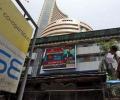
Shares of Avenue Supermarts (DMart) have rallied 15 per cent in the past month, even as the benchmark National Stock Exchange Nifty has remained flat. The stock has garnered favourable commentary from both fundamental and technical analysts after three years of poor performance. "DMart has reached its first 52-week high since October 2021, taking off from solid base formations.

Equity fundraising through initial public offerings (IPOs) rose 20 per cent during the financial year 2023-24 (FY24). During the period, 76 Indian corporates raised Rs 61,915 crore through main board IPOs, compared to Rs 52,116 crore mobilised by 37 IPOs in 2022-23, as disclosed by PRIME Database. However, if one excludes the mega Life Insurance Corporation (LIC) IPO, which came out in 2022-23, IPO mobilisation increased by 58 per cent from last year.

The initial public offerings (IPOs) by small and medium enterprises (SMEs) hit a new high in 2023-2024 (FY24). In this financial year, data from the Prime Database showed that 190 companies raised Rs 5,579 crore through the SME IPO route. This financial year's tally bettered the fundraising in the previous financial year when 125 companies raised Rs 2,235 crore.

Equity fundraising through initial public offerings (IPOs) rose 20 per cent during the financial year 2023-24 (FY24). During the period, 76 Indian corporates raised Rs 61,915 crore through main board IPOs, compared to Rs 52,116 crore mobilised by 37 IPOs in 2022-23, as disclosed by PRIME Database. However, if one excludes the mega Life Insurance Corporation (LIC) IPO, which came out in 2022-23, IPO mobilisation increased by 58 per cent from last year.

In addition to regulatory actions against small and midcaps, tighter liquidity conditions are another headwind that stocks are facing this month. Market observers say advance tax outflows and capital gains-related adjustments will weigh on the markets in the near term.

For the third month running, investors opened over four million new demat accounts in February, showing growing household confidence in stock markets and their increased risk appetite. Over 13.12 million new demat accounts have been opened in the last three months, taking the total count close to the 150-million mark. Demat accounts are needed for trading and holding shares electronically.

Equity fundraising through qualified institutional placements (QIPs) has gained traction, thanks to supportive equity markets and the need for fresh fundraising to meet capital expenditure (capex) requirements.

More than half a dozen private-sector banks are awaiting regulatory approval for the appointment of a second whole-time director on their boards.
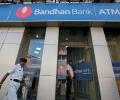
It is 10 years since Bandhan Financial Services became the first microfinance institution (MFI) to receive the universal bank licence. A year later, in 2015, it started operations. Bandhan's entry into banking was seen as a vote of confidence by the Reserve Bank of India (RBI) for the country's microfinance sector. Subsequently, the RBI awarded small finance bank licences to nine MFIs.

It's not only the Indian markets that command a valuation premium over their global peers; shares of subsidiaries of India-listed multinational companies (MNCs) also trade at rich valuations compared to their parent companies. An analysis of 12-month forward price-to-earnings (P/E) and price-to-book (P/B) multiples of domestically listed MNCs shows that most quotes have a premium ranging from 2.1x to 6x that of their parent. Similarly, P/B, in most cases, is significantly higher in the domestic market.

HDFC Bank has been conscious in not accepting high-cost deposits, which have resulted in slower growth in October-December, said Sashidhar Jagdishan, managing director and chief executive officer, during an interaction with Goldman Sachs recently. He said during times of tight liquidity, short terms hardened, as was the case in October-December. "Not only did we participate, but we also gave up which came up for maturity," he said.

Standard Chartered's India strategy will focus on wealth management while credit card will remain core to its business though will avoid competition with the country's private banks, said a senior executive of the British lender. "Our focus on wealth management and affluent clients are central to our existence. "We are strong in these areas and we want to grow in these areas.

'Historically, the markets tend to perform well during election years as governments aim to increase spending and call attention to growth.'

'Our unsecured loan is not exactly unsecured. It is backed by cash flow of customers.'

The income-tax department is set to launch a screen-based automated reconciliation system for plugging mismatches between returns filed by taxpayers and information processed by the department.

'For the first time ever it has come below 1 per cent, at 0.97 per cent.'

'Investment creates capacity and reduces inflation. Income, employment, and savings rise.'

The new scheme may be announced before the Lok Sabha elections.
 © 2026 Rediff.com - Investor Information - Advertise with us - Disclaimer - Privacy Policy - Sitemap - Feedback - About us - Terms of use - Grievances